



Advance payment for a business trip: How to issue and settle it, step by step?
In this guide, you will read about:
- What is a business travel advance?
- Is a business travel advance mandatory?
- How much should a business travel advance be?
- Example: an advance for a domestic business trip
- How do you request a business travel advance?
- How can an advance be paid: in cash or by bank transfer?
- Advance payments for international business trips: currency and NBP exchange rates
- What documents are needed to settle a travel advance?
- What is the deadline for settling an advance?
- How do you calculate the balance: repayment or additional reimbursement?
- Example of settling an advance
- How do business travel advances work on worktrips.com?
- How does worktrips.com improve the advance payment process?
- The most common mistakes with business travel advances
- An advance does not have to mean another spreadsheet
- Frequently asked questions about business travel advances
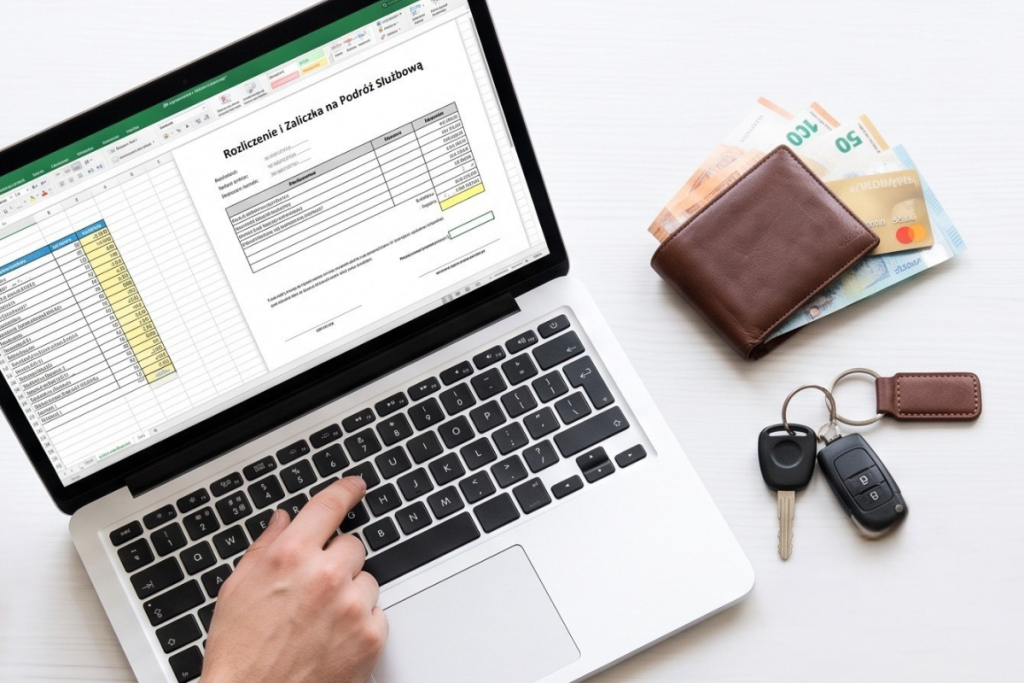
A common scenario: An employee travels to visit a client for three days. The company has already paid for the ticket and hotel, but there will be local transport and other expenses during the trip. Should the employee pay out of pocket and then wait for reimbursement? Not necessarily. That is exactly what a business travel advance is for. Yet a simple arrangement can turn into a maze of accounting questions. Who submits the request? How is the amount determined? Must the advance be paid in cash, or can it be transferred to a bank account? What about currency when travelling abroad? And most importantly, who owes whom money after the employee returns? In this guide, we walk through the entire process—from requesting a business travel advance to calculating the final balance.
What is a business travel advance?
A business travel advance is money provided to an employee before departure to cover anticipated, necessary business travel expenses. It is neither additional salary nor a flat-rate bonus for travelling. These are company funds that the employee must account for after returning. An advance may cover, among other things:
- tickets, if the company has not already purchased them;
- accommodation paid for at the destination;
- estimated daily allowances and lump-sum reimbursements;
- local transport;
- road tolls and parking fees;
- other justified expenses approved by the employer.
If flights, train tickets, hotels or car rentals have already been paid for directly by the company, their costs should not be added to the employee’s advance again. The advance is intended to cover the expenses the employee will actually have to pay.
Is a business travel advance mandatory?
The answer depends on the type of trip and the employer’s policies.
| Type of trip | Rule under the regulation | How is the amount determined? | Currency |
| Domestic business trip | The employer grants an advance at the employee’s request | Based on a preliminary estimate of necessary expenses | Usually PLN |
| International business trip | The employee receives an advance for necessary expenses | Based on a preliminary estimate of trip expenses | Foreign currency; PLN is also possible with the employee’s consent |
These rules are set out in Sections 11 and 20 of the business travel regulation. The regulation applies directly to employees in Poland’s central and local government budget-funded sectors.
In private companies, the terms for paying business travel entitlements may be established in a collective bargaining agreement, remuneration regulations or an employment contract. Where no such provisions exist, the rules of the regulation apply accordingly. This is also explained by the Polish Ministry of Family, Labour and Social Policy.
The practical takeaway? Before a company starts paying travel advances, it should describe the process in its travel policy or business travel expense procedures. Legislation provides the framework, but clear internal procedures make day-to-day operations manageable.
How much should a business travel advance be?
There is no single statutory amount or fixed percentage of travel costs. The advance should be based on a preliminary estimate of expenses the employee will actually need to cover.
The best approach is to calculate it in three steps:
- Estimate all necessary trip expenses. Include transport, accommodation, daily allowances, local travel and other approved costs.
- Deduct expenses the company has already paid. A hotel booking paid directly by the company should not be included in the advance a second time.
- Check company limits and policies. The amount should be sufficient without being arbitrarily inflated ‘just in case’.
Example: an advance for a domestic business trip
An employee is travelling from Poznań to Warsaw for 36 hours. The company has already booked and paid for the train ticket and hotel through the platform, so the employee does not need to pay for them. The expected expenses to be covered by the employee are:
- daily allowances: PLN 90,
- local transport: PLN 18.
The preliminary estimate is PLN 108. There is no reason to add the hotel and train, as these services have already been paid for without using the employee’s personal funds. To estimate daily allowances, mileage reimbursement and additional expenses, you can use the worktrips.com business travel calculator. The result should still be checked against the policies applicable at the company concerned.
How do you request a business travel advance?
Polish regulations do not require every private company to use one official form. However, the request should provide a clear record of who needs the money, which trip it relates to, the amount requested and the basis for it. A good advance request includes:
- employee details;
- travel destination and dates;
- a reference to the relevant travel order or business trip request;
- the requested advance amount;
- the currency;
- a short estimate or justification of the amount;
- the payment method;
- the bank account number if the advance is to be transferred;
- approval by an authorised person.
How can an advance be paid: in cash or by bank transfer?
An advance can be paid through the company’s established financial process—for example, by bank transfer to the employee’s account or in cash from the company cash desk. A cashless payment is usually the most convenient option today, since the amount, date and recipient can easily be verified. It is also worth distinguishing an advance from a corporate payment card. A card can reduce the need for employees to use their own funds, but it does not remove the obligation to allocate transactions to the relevant trip, collect supporting documents and settle any remaining entitlements.
Advance payments for international business trips: currency and NBP exchange rates
For international travel, it is easy to confuse three different things: the currency of the advance, the currency used for the final settlement with the employee, and the exchange rate used to record transactions in the accounts. These are not always the same. Under Section 20 of the regulation:
- the employee receives an advance in foreign currency to cover necessary expenses for international business travel;
- with the employee’s consent, it may be paid in Polish zloty; the equivalent is calculated using the NBP average exchange rate on the date the advance is paid;
- international travel expenses may be settled in the currency of the advance, in a convertible currency or in Polish zloty using the average exchange rate on the date the advance was paid.
What documents are needed to settle a travel advance?
Paying the advance is not the end of the process. After returning, the employee must report actual, eligible travel expenses and compare them with the amount received. A well-organised process will usually include:
- a business trip request or travel order;
- the advance request, including its amount, currency and estimate;
- confirmation of approval;
- confirmation that the advance was paid;
- invoices, receipts and tickets documenting expenses;
- information needed to calculate daily allowances and lump-sum reimbursements;
- a mileage log where mileage reimbursement is claimed;
- the final expense settlement showing the amount to be repaid or reimbursed;
- confirmation of repayment of unused funds or an additional payment to the employee.
If a supporting document cannot be provided, the employee submits a written declaration of the expense and explains why the document is missing. Read more about the entire process in our guide: Business Travel Expense Settlement: Step by Step.
What is the deadline for settling an advance?
Domestic or international business travel expenses should be settled no later than 14 days after the trip ends. In practice, this settlement also includes any advance received, as only a comparison of all entitlements and expenses shows whether the employee must repay part of the funds or the company owes an additional amount. The company’s internal procedure may also specify:
- who receives the expense settlement;
- the required format for submitting documents;
- how long the approver has to review it;
- when the company makes any additional payment;
- how the employee returns any unused advance;
- what happens if a trip is cancelled.
If the trip does not take place, there are no travel expenses against which to settle the advance. The company’s travel policy should therefore require the prompt return of the funds and clearly explain the procedure.
How do you calculate the balance: repayment or additional reimbursement?
The final settlement can be reduced to one simple calculation:
approved business travel expenses – advance paid = settlement balance
| Result | What happens? |
| Expenses exceed the advance | The company pays the employee the difference |
| Expenses are lower than the advance | The employee returns the unused amount |
| Expenses equal the advance | The balance is zero |
Example of settling an advance
An employee received an advance of PLN 1,500. After returning, their approved entitlements and expenses totalled PLN 1,380.
PLN 1,380 – PLN 1,500 = –PLN 120
This means the employee must return PLN 120 to the company. If approved costs had totalled PLN 1,620, the company would have paid the employee an additional PLN 120. Simple enough in theory. Problems arise when the advance is recorded in one spreadsheet, receipts are scattered across emails, the hotel appears on a separate invoice and the daily allowance is calculated in yet another application. That is why the advance should remain linked to the same business trip throughout the process.
How do business travel advances work on worktrips.com?
In the worktrips.com business travel management module, employees can request an advance when submitting a business trip request. They do not need to create a separate spreadsheet or later work out which trip the payment related to.
The process works as follows:
- The employee creates a business trip request. They enter the destination, dates and key details of the planned trip.
- They request an advance. They provide the amount, currency, bank account number and justification. This gives the finance department the information required to arrange the payment.
- The request is submitted for approval. An authorised person decides according to the agreed approval workflow, while the employee can check the current status.
- The company pays the advance. Once approved, the transfer or cash payment is made according to the organisation’s financial procedures.
- After approval, the employee books the trip. They can arrange their hotel, flight, train or car through the same platform. All information remains linked to the business trip.
- After returning, they start settling the same trip. The system uses details entered earlier, so they do not have to start with a blank form.
- They add daily allowances, mileage and other expenses. The length of the trip and any meals provided are taken into account when calculating the daily allowance. Employees who used their own car can also claim mileage reimbursement.
- They attach documents. A photograph or PDF of an invoice or receipt can be assigned to a specific expense and trip. Information from the uploaded document is automatically extracted and entered.
- The system displays the final balance. Daily allowances, mileage, other expenses and the advance appear in one summary. Once the amounts are totalled, it is clear whether money must be returned or an additional payment is due.
- The settlement goes through approval and further processing. The data can be used in reports, accounting exports and integrations with financial or ERP systems.
A detailed overview of submitting requests and settling expenses from the traveller’s perspective is available on the business travel expense settlement for employees. Finance and administration teams can find a broader description of the workflow on the business travel expense settlement for companies.
How does worktrips.com improve the advance payment process?
The greatest benefit is not simply moving a form online. It is continuity of data. The same advance amount follows the trip from request to final balance, while documents, comments and approvals remain attached to the right journey. Employees know the status of their requests. Approvers can see the reason for the amount requested. Finance teams do not have to search for a transfer by surname and match it to a trip. Accounting receives organised data for further processing.
The most common mistakes with business travel advances
Guessing the amount
A round figure of PLN 2,000 may seem convenient, but without an estimate there is no way to know whether it reflects actual needs. The advance should be based on the travel plan and expenses the employee must cover.
Paying for the same expense twice
The company has already paid for the hotel, but the full accommodation cost is nevertheless included in the advance. The result? An excessive payment followed by an avoidable repayment.
No link to a specific trip
A bank transfer labelled only ‘advance’ makes it difficult to identify which trip it relates to. The request, payment and settlement should share an identifier or form part of one workflow.
Documents sent through multiple channels
An invoice in an email, a photo of a receipt in a messaging app and a spreadsheet in a team folder are a recipe for missing entries. Documents should be assigned directly to the relevant expense and trip.
No repayment deadline for cancelled trips
If the trip never takes place, the advance should not remain outstanding until the end of the month. The company’s procedure should cover this situation.
Automatically deducting the full amount from salary
Poland’s Labour Code includes cash advances granted to employees among amounts that may be deducted from pay, but it sets out the order of deductions, applicable limits and protected minimum amounts. An unsettled advance should therefore not be treated as an arbitrary charge that can be deducted in full from the next salary payment without review. The specific case should be assessed by HR or payroll.
An advance does not have to mean another spreadsheet
A well-designed process is almost invisible: an employee requests the amount needed when applying for a trip, the responsible person approves it, finance pays the advance and, after the employee returns, the system compares it with approved expenses. The final result is a single balance: money to return, an additional amount to pay or zero. A spreadsheet may be enough for a company managing only a few business trips each year. With dozens or hundreds of trips, however, calculating the figures is no longer the main challenge. Most time is spent managing workflows, documents, statuses and responsibilities. The worktrips.com business travel management module connects these steps with travel bookings and subsequent reporting, ensuring that the advance does not get lost between the request and the accounting department.
Frequently asked questions about business travel advances
Does an employee have to request an advance for a domestic business trip?
Under the regulation, an employer grants an advance for necessary domestic business travel expenses at the employee’s request. In a private company, the provisions of the remuneration regulations, collective bargaining agreement, employment contract or travel policy should also be checked.
Is an advance mandatory for international business travel?
Under the arrangement specified in the regulation, employees receive an advance for necessary international business travel expenses. The amount is based on a preliminary cost estimate. Private companies should compare this rule with their internal policies.
Can an advance be paid by bank transfer?
Yes. An advance does not have to be paid in cash. A company can transfer it to the employee’s bank account if its financial procedures allow this. The approved request and proof of payment should be retained.
Can an international travel advance be paid in Polish zloty?
Yes, but the regulation requires the employee’s consent. The amount in zloty is the equivalent of the foreign-currency advance calculated at the NBP average exchange rate on the payment date.
How long does an employee have to settle an advance?
Domestic or international business travel expenses must be settled no later than 14 days after the trip ends. The settlement also covers the advance received and calculation of the final balance.
What if the employee spent less than the advance?
Once the expenses are approved, the employee returns the unused portion of the advance using the method specified by the company, such as a bank transfer or cash payment.
What if expenses exceeded the advance?
If the expenses were necessary, complied with company policies and were properly documented, the employer reimburses the difference shown in the settlement.
Does a daily allowance require an invoice or receipt?
No. Supporting documents must be attached for individual expenses, but this requirement does not apply to daily allowances or expenses covered by lump-sum entitlements.
What should an employee do if a document is lost?
If the document cannot be provided, the employee submits a written declaration of the expense and explains why the document is missing. This does not automatically mean that every expense will be accepted—it must still be justified and comply with company policy.
Is an advance a company expense as soon as it is paid?
The payment itself is primarily an amount to be settled with the employee. Costs are recognised on the basis of the expense settlement and appropriate accounting evidence. The detailed accounting treatment should follow the organisation’s accounting policy.
Does a corporate card replace an advance?
It can reduce the need to pay advances, but it does not replace travel expense settlement. Transactions still need to be allocated to the appropriate trip, verified and matched with the required documents.