



Corporate expectations regarding business travel management: perspectives from HR, finance, administration, and employees
In this guide, you will read about:
- Why does business travel management require a broader perspective?
- Three situations that prompt companies to change how they manage business travel
- One business trip from four perspectives
- HR: predictability and conditions that support employees
- Finance: total costs and data ready for expense settlement
- Administration: less repetitive work and clearer responsibility
- Employees: control over their trip and help when needed
- How can companies balance savings, convenience and control?
- A travel platform: a new approach to organising business trips
- The WorkTrips compass: what companies expect from business travel management
- Availability and scope of services — how can we cover the trips our business needs?
- Cost control — what does the entire trip cost?
- Efficient organisation — what takes up most of our time?
- Autonomy and comfort — how much choice does the employee have?
- Safety and support — who helps when plans change?
- Documents and expenses — how do we close out a business trip?
- Data for optimisation — what can we improve?
- Fit and implementation — how will we manage the transition?
- How can you use the compass in your company?
- How does worktrips.com turn expectations into everyday practice?
- Good business travel management is measured by how well it works for people
- Frequently asked questions about business travel management

An employee wants to reach a business meeting without a stressful connection. The administration team needs an approved travel request and booking details. Finance checks the exact costs, while HR considers whether the itinerary leaves enough time to rest before the next working day. Everyone is involved in the same business trip, but each sees a different part of it. Today, companies expect much more from business travel management than access to flights and hotels. Efficient service, predictable costs, safety, employee autonomy, and documents and data accessible to the right people all matter. These needs should be balanced before comparing providers. In this context, implementing a business travel management platform changes how a company works. The organisation defines who makes decisions, what employees can handle themselves, and when they need assistance. The platform then helps put those arrangements into practice.
Why does business travel management require a broader perspective?
For a company supplying equipment to manufacturing plants, business travel may involve sending an installation team and later service technicians. In construction, it might mean a site manager travelling to an overseas project. In other organisations, employees regularly visit clients, carry out implementations or work at different facilities. Without being physically present, the company could not deliver its service or fulfil its contract.
In these situations, the question is how to organise essential trips efficiently. A travel management partner helps employees reach their destination, streamline bookings and expense settlements, and improve the entire process. To do so, the provider needs information that matters to the business: dates, work locations, the number of travellers and accommodation requirements. The need for a structured approach therefore also depends on how frequently employees travel and how important those trips are to operations.
When travel is a regular part of the job, it should be managed like any other operational process, with clear rules, responsibilities, data flows and procedures for exceptions. Booking, approval and expense settlement should follow agreed arrangements rather than require a separate discussion every time.
Three situations that prompt companies to change how they manage business travel
Our conversations with companies reveal different starting points. Some are looking for a new travel partner; others want to give employees a self-booking tool for the first time.
| Company situation | Reason for considering a change | Main expectation |
| The company wants to switch its current provider | The quality of support, scope of services, reporting arrangements or terms of cooperation no longer meet its needs | A new partner that solves a specific problem and ensures a smooth transition |
| The company mainly uses email and telephone services provided by a traditional travel agency | More coordination is needed, waiting for quotes slows things down, and information is spread across several people | Self-service bookings within company policy and access to data without requesting a new report each time |
| Business trips are organised internally by the administration team | As travel volumes increase, so does the workload of the person coordinating trips | Managing more trips without a proportional increase in manual work |
These situations can overlap. A company may use an external travel agency while handling approvals, collecting documents and preparing reports internally. The challenge then lies in connecting stages that operate separately. Before choosing a solution, it is worth mapping out how the company's entire business travel process currently works. Only then can the company identify what needs to change.
One business trip from four perspectives
HR: predictability and conditions that support employees
From an HR perspective, what matters is how travel affects the employee. Are the rules easy to understand? Do employees know where to get help? Are travel time, rest and individual needs taken into account when planning?
A hotel far from the meeting venue may be within budget but require additional journeys. An early flight may suit the client the employee is meeting while forcing the employee to leave home in the middle of the night. These details should inform travel policies rather than leave employees dealing with the consequences of an arbitrary choice. We explore this perspective further in our article on employee comfort during business travel.
The SAP Concur Global Business Travel Survey 2026 found that 67% of surveyed business travellers had concerns about work-related travel that year, including safety and disruptions. This illustrates why support and predictability deserve attention alongside costs.
Finance: total costs and data ready for expense settlement
The finance department needs to know how much the company spends, what the money is spent on and which team or project each expense belongs to. The price displayed when searching for a ticket is only the starting point. Other costs can include baggage, ground transport, parking, accommodation, booking changes and additional employee expenses. Cancellation terms and service fees also matter. A cheaper offer may be less attractive if the meeting date is uncertain. Finance also needs consistent information: the correct cost centre, supporting documents and advance-payment details. That enables accounting teams to work with prepared expense reports rather than reconstructing a trip from messages and attachments.
Administration: less repetitive work and clearer responsibility
The person organising business trips often handles many other responsibilities as well. As travel volumes grow, every extra email, schedule change and repeated request for a document adds to the workload. From this perspective, an effective process should make it easy to see what is awaiting approval, who is responsible for the next step and which matters require intervention. Cover arrangements and access to the history of decisions are equally important.
Introducing a platform changes the nature of this work. When employees handle repetitive tasks themselves, administration can focus more on policies, exceptional situations and service quality. The team continues to play an important role in organising travel, but gains different tools to fulfil it.
Employees: control over their trip and help when needed
The traveller knows when they need to arrive, what local transport they need and which connection best fits their working day. Being able to choose from options that comply with company travel policy makes use of that knowledge. Employees also need clear answers: what can they book, which expenses will be approved, how do they submit expenses, and whom should they contact if plans change? Self-booking for business travel should go hand in hand with access to support. When an itinerary is complex, a change is urgent or travel is disrupted, employees need to know when and how to contact a travel agent.
How can companies balance savings, convenience and control?
Suppose a cheaper hotel is far from the client's office. Savings on the room may be offset by transport costs, while the employee loses valuable time. Comparing room rates alone gives the company an incomplete picture. The same applies to fare selection. If a meeting date is certain, a non-refundable fare may make sense. But for a project whose schedule changes frequently, the potential cost of changing or buying another ticket should be considered.
Company expectations therefore need to become decision-making rules: when to choose a flexible fare, how to assess hotel location, who can approve spending above a limit and what justification is required. A sound business travel policy helps reconcile these perspectives. It establishes a common framework while allowing for situations that call for individual decisions.
A travel platform: a new approach to organising business trips
Moving to a platform requires the company to define which decisions employees may make independently, which rules the system should apply and who should have the necessary permissions.
| Area | Service based on individual arrangements | Service based on a shared process |
| Travel selection | The coordinator collects preferences and presents options | An authorised employee chooses an option within company policy |
| Approval | Approvals are communicated through messages | Requests reach the appropriate approver, and decisions remain linked to the trip |
| Documents | Attachments must be collected from several places | Each document is linked to the relevant trip and expense |
| Reporting | Reports are compiled by manually combining data | The company uses data captured throughout the travel process |
| Exceptions | Handling depends on the knowledge and availability of particular people | Responsibilities, cover arrangements and support procedures are clearly defined |
This comparison concerns ways of working. Travel agent assistance still has a place, and companies can combine it with self-booking. The key is maintaining continuity of information. The innovation lies in linking stages and redistributing responsibilities. Employees gain more control, approvers make decisions based on relevant data, and administration and finance work from a shared view of each trip.
The WorkTrips compass: what companies expect from business travel management
The WorkTrips compass is a framework for organising business travel needs. It brings together the questions companies ask when selecting a provider with the perspectives of employees and the teams managing trips. At its centre is one shared goal: travel tailored to how the company operates. Eight areas surround this goal. They are not a ranking or an implementation sequence. They help determine whether a decision considers the entire process.
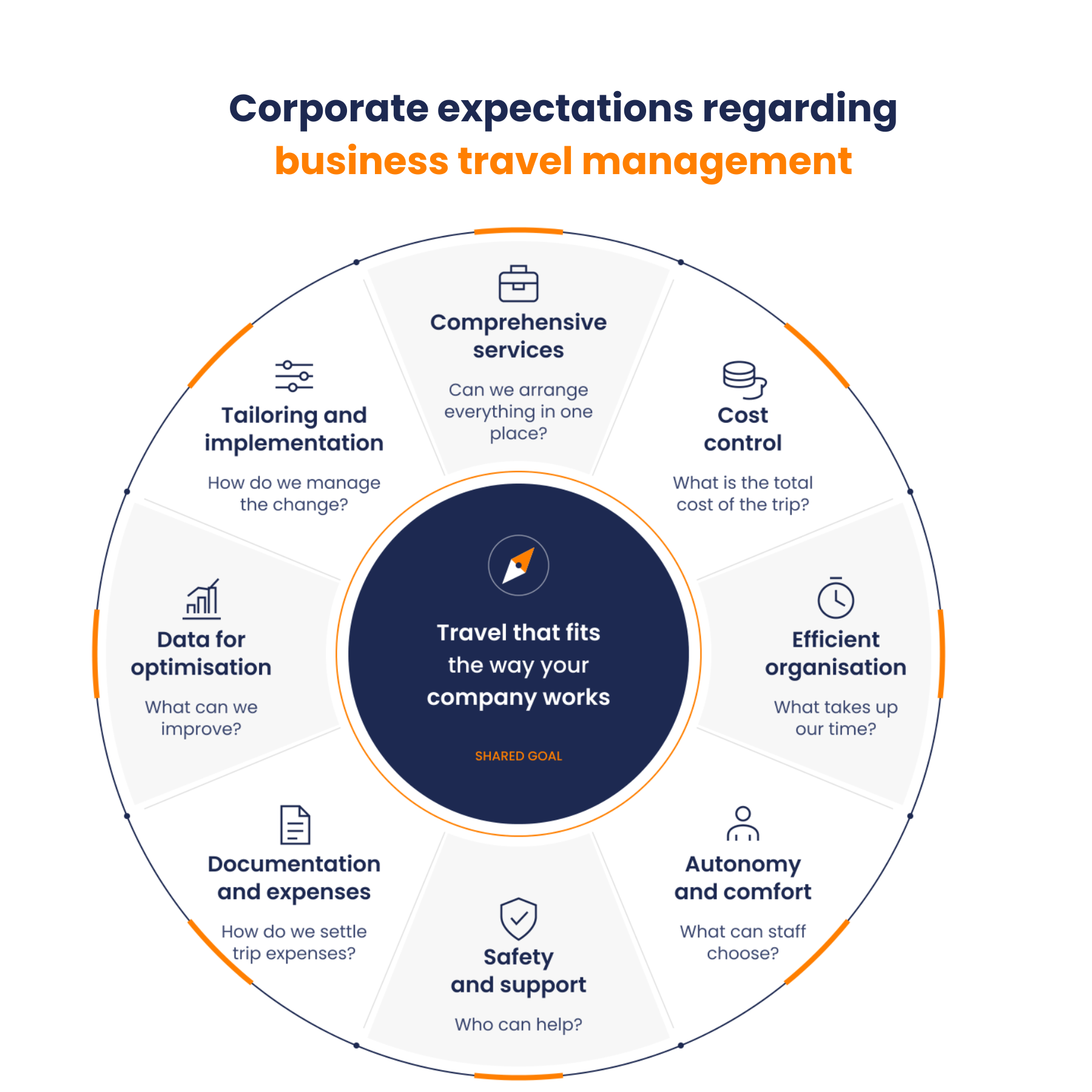
Availability and scope of services — how can we cover the trips our business needs?
Companies need solutions that reflect how their employees travel. Important considerations include available transport connections, accommodation close to the worksite, last-mile transport and the ability to organise group trips or longer stays.
Question to agree on: does the scope of service match our routes, schedules and on-site working conditions?
An installation team may depart from several cities, need a hotel near the plant and require a car on arrival. A construction manager may return regularly to the same project. It is worth checking how a provider handles these situations, urgent trips and extended stays. The service scope and delivery terms should be agreed before cooperation begins.
Cost control — what does the entire trip cost?
A company needs a predictable budget, transparent fees and the ability to allocate costs to the appropriate departments or projects.
Question to agree on: which costs do we consider before approving a trip, and how do we verify the final expenditure?
When comparing providers, it is worth clarifying fees for bookings, changes, cancellations and agent assistance. The terms of cooperation should make it possible to estimate costs based on how the company actually travels. You may also find this article helpful: How much does a business travel management platform cost?
Efficient organisation — what takes up most of our time?
Look for recurring bottlenecks: waiting for approval, completing missing information, searching for documents or repeatedly preparing quotes.
Question to agree on: which tasks can follow standard rules, and which require a human decision?
Useful measures of improvement include the time between a travel request and booking, and the number of cases returned for additional information. Companies can also track these metrics outside the platform.
Autonomy and comfort — how much choice does the employee have?
Employees should be able to tailor a trip to their assignment and personal needs within agreed boundaries.
Question to agree on: what can travellers choose themselves, and when do they need further approval?
Consider departure times, hotel location, parking availability and travellers' individual needs. If the company allows extending a business trip for personal reasons, approval requirements, cost allocation and expense settlement should be agreed in advance.
Safety and support — who helps when plans change?
Both the company and its employees need a clear procedure for cancelled flights, delays, hotel problems or urgent itinerary changes.
Question to agree on: who provides assistance, during which hours and through which channels?
When choosing a partner, check the scope of support, available languages, out-of-hours contact arrangements and responsibility for specific actions. The ability to search for trips in a system does not replace a support procedure. In this context, it is worth exploring the Traveler Tracker feature.
Documents and expenses — how do we close out a business trip?
Information needed after employees return should already be collected while planning the trip. This includes the purpose of travel, advance payments and cost allocation.
Question to agree on: what does the employee complete, what does the manager verify and what information does accounting receive?
The company should also define how invoices and receipts are processed, and how per diems, mileage and additional expenses are settled. A consolidated invoice for booked services serves a different purpose from the settlement of employee travel allowances and expenses.
Data for optimisation — what can we improve?
Reports help identify the destinations employees visit most often, the routes and accommodation that generate the highest costs, and changes in spending across projects. This information can guide improvements in how essential business trips are organised.
Question to agree on: what information will help us plan bookings better, control spending and reduce the time spent managing trips?
Repeated stays in one city may justify negotiating hotel rates. Frequent last-minute bookings may indicate that lengthy approvals are slowing down employees and administrators. Changes in hotel prices may justify updating travel policy limits. In each case, identify the data required and confirm which information the provider includes in reports and which must be collected separately. For companies with environmental objectives, this may also include travel-related emissions. We explain how to use such information in our article on business travel as a source of business data.
Fit and implementation — how will we manage the transition?
The solution should reflect the company's structure, user roles, expense approval procedures and accounting requirements.
Question to agree on: what settings, training, data and connections to other systems do we need?
It is worth distinguishing between features available immediately, those requiring configuration and those that still need to be agreed with the provider. IT involvement depends on the organisation's security and integration requirements. The implementation timeline, costs and each party's responsibilities should also be established.
How can you use the compass in your company?
Include administration, finance, HR, travel approvers and employees who travel regularly in the discussion. Travellers' input is particularly valuable because it reveals difficulties that do not appear in cost reports.
You can start with five steps:
- Map the current process. Identify where requests, approvals, bookings, documents and reports are created.
- Collect challenges from different perspectives. Ask each group what makes their work difficult and what the consequences are.
- Choose three priorities. For example, faster approvals, complete expense reports and independent travel selection.
- Turn needs into requirements. Rather than saying “we want better reports”, specify the fields, recipients and reporting frequency.
- Agree on how to measure results. Compare the situation before and after the change: processing time, document completeness, costs and employee experience.
These requirements help both when switching partners and when introducing a first travel platform. During a product demonstration, test a scenario from your own business: a client visit, an absent approver, a schedule change and the settlement of a travel advance.
How does worktrips.com turn expectations into everyday practice?
With worktrips.com, companies can combine self-booking with travel policies, approval workflows, agent support and reporting. Employees select trips within agreed boundaries, while managers can access the information they need to maintain control. The Business Travel Expense Module connects the formal stages of a trip:
Request → Approval → Booking → Expense settlement
An employee submits a travel request, can request an advance payment and checks the approval status. Once approved, they proceed to booking. After returning, they enter the information needed to calculate per diems and mileage, add other expenses and attach supporting documents. A photo or PDF of a receipt can be used to automatically extract data and prefill the form; the employee reviews the information before submitting the expense report.
An authorised person reviews allowances, attachments, the advance payment and the final balance, then approves or rejects the expense report. Available reports and settings depend on the company's account configuration. The most important change is that agreed policies guide employees throughout the trip management process. The company can gradually develop this way of working to suit its needs.
Good business travel management is measured by how well it works for people
Business travel expectations are best discussed before the next trip triggers a series of individual arrangements. Employees should know what they can do independently; administration should know which matters need its attention; finance should know where to find complete data; and HR should know what support and conditions travellers can expect. The compass helps everyone find a common direction, even when departments have different priorities. This conversation is the starting point for a new approach to organising business trips: designing a process that supports work, gives employees room to choose and maintains control. Want to see how these expectations could become a practical process in your organisation? Schedule a no-obligation consultation and show us how you currently manage travel — together, we can explore solutions that work for your business.
Frequently asked questions about business travel management
What do companies expect from business travel management?
Companies expect efficient trip organisation, predictable costs, access to suitable transport and accommodation, and assistance when plans change. Clear rules for booking, approval and expense settlement also matter. Travel arrangements should reflect how the company operates day to day, from regular client visits to trips by installation technicians, service engineers and project teams.
What matters to HR when organising business trips?
For HR, safety, employee comfort and clear travel policies are priorities. Itineraries should take travel time, rest and on-site working conditions into account. Employees also need to know which expenses the company covers and where to get help if a flight is cancelled or accommodation needs to be changed.
What business travel information does the finance department need?
Finance needs a complete breakdown of expenses and the ability to assign them to an employee, department or project. Beyond ticket and hotel prices, it must account for local transport, baggage, booking changes and employee allowances. Supporting documents, travel advances and approved expense reports should be linked so accounting can verify how the final amount was calculated.
How can administration teams manage business trips more efficiently?
Common travel request procedures, clearly assigned responsibilities and access to up-to-date trip information make administration more efficient. Employee self-booking and organised document workflows also help. This allows the travel coordinator to focus on matters requiring intervention instead of repeatedly gathering the same information through emails.
What do employees expect from business travel services?
Employees want convenient connections, accommodation in suitable locations and the freedom to choose trips within company policy. They need to know what requires approval, how to claim expenses and whom to contact for help. Easy access to booking confirmations and useful travel information is also important.
Can employee self-booking still provide cost control?
Yes, provided self-booking is linked to travel policies, spending limits and appropriate approvals. Employees select options within boundaries set by the company, while exceeding a limit may require additional approval. User permissions and procedures for exceptions should be established before the platform is implemented.
What changes when a business travel management platform is implemented?
Introducing a platform changes how travel responsibilities and information are distributed. Employees can handle some tasks independently, managers receive requests requiring approval, and administration and finance work with structured data. Implementation should therefore also include agreements on policies, responsibilities and travel expense settlement.
How do reports help optimise business travel?
Reports reveal the most common destinations, transport and accommodation costs, and spending by teams or projects. Regular stays in the same city may justify negotiating hotel rates. Analysing booking dates and approval times can also identify why purchases are made at the last minute. The scope of available data should be confirmed with the provider.
Does using a platform mean giving up travel agent support?
A platform can combine self-booking with assistance from travel agents. With worktrips.com, travellers can seek help with matters they cannot manage themselves, such as complex itineraries or urgent changes of plan. Whether a booking can be changed or cancelled depends on the terms of the purchased fare or offer. The scope and hours of support should be checked in the service agreement.
How should a company choose a business travel management provider?
Start with the needs of employees, administration, HR and finance. Compare the range of services, fees, support arrangements, booking capabilities, reporting, expense settlement and implementation process. During a demonstration, test a real-life scenario: several service engineers travelling to a plant, an extended stay or a changed return date.