



Negotiated rates with hotels and airlines. How to use them for business travel?
In this guide, you will read about:
- What are negotiated rates?
- When is it worth negotiating hotel rates?
- How to negotiate hotel prices for your company?
- Is the corporate rate always the cheapest?
- Rates negotiated with airlines
- Corporate tariffs and loyalty programs can run in parallel
- How to implement your own rates on the worktrips.com platform?
- How to increase the utilization of negotiated rates?
- Frequently asked questions

Regular business trips to the same destinations can become a basis for negotiating more favorable terms with hotels and carriers. This not only allows the company to reduce expenses but also provides greater predictability of costs and booking terms. Custom contracts are no obstacle to implementing a business travel management platform. Rates negotiated with hotels and airlines can be implemented on worktrips.com and then shared with company employees. This allows the team to continue using the negotiated terms but book travel through a single tool.
What are negotiated rates?
Negotiated rates, also known as corporate or business rates, are terms agreed upon directly between a company and a travel service provider. In the case of business travel, the provider may be a hotel, hotel chain, or airline. Negotiations don't have to be solely about price. The agreement may also cover:
- conditions for cancellation and change of reservation,
- breakfast included in the price,
- free parking or internet access,
- specific room standard,
- checked baggage,
- possibility of changing the flight date,
- range of routes or booking classes,
- the duration and availability of the agreed terms.
When evaluating an offer, it's worth comparing the total cost and booking flexibility. A cheaper overnight stay without breakfast and with restrictive cancellation policies won't always be more advantageous than a slightly more expensive corporate rate.
When is it worth negotiating hotel rates?
The best basis for negotiations with a hotel is a regular and quantifiable volume of overnight stays in a specific location. Therefore, it's not just about the size of the company itself, but primarily about the repeatability of travel. Let's assume that company representatives visit clients in Warsaw or Gdańsk several times a month. They typically choose properties located in the same part of the city, as this allows them to reduce the time and cost of local travel. The company can collect data on previous reservations, select the most frequently used hotels, and propose ongoing cooperation. Negotiations are worth considering when:
- employees often travel to the same cities;
- the company regularly chooses a specific hotel or chain;
- the accommodation must be close to the client, branch or plant;
- the annual number of overnight stays can be estimated;
- Cost predictability is important for the company budget;
- standard booking conditions are too inflexible.
Before starting negotiations, it's important to compile not only historical data but also planned projects, events, and new destinations. The hotel will be primarily interested in the real potential for collaboration.
How to negotiate hotel prices for your company?
Effective negotiations start with data. It's worth examining the number of nights, average room rates, most popular destinations, and seasonality. To make this task easier, the process can be organized in a few steps:
- Gather data on your previous accommodations. Determine the number of reservations, expenses, and key travel destinations.
- Estimate future demand. Include planned projects, training, client meetings, and recurring trips.
- Choose a few suitable properties. Price is important, but location, standard, and availability also matter.
- Ask for comparable offers. Each hotel should provide terms and conditions for a similar room type and range of services.
- Negotiate all the terms and conditions. Check the price, breakfast, parking, cancellation policy, local taxes, and excluded dates.
- Determine how you'll book. Ask if the rate can be made available through your company's reservation system.
- Regularly evaluate your partnership. Analyze the availability of the agreed-upon rate, contract utilization, and the actual cost of stays.
You also need to determine whether the hotel guarantees the availability of the rate or only offers it when rooms are available.
Is the corporate rate always the cheapest?
Not always. A hotel's public promotion for a specific date may turn out to be cheaper than the contracted rate. However, the comparison is only meaningful if it includes the same room standard, range of services, and cancellation policy. A corporate rate can also be advantageous if it's not the lowest price shown in the results. Its advantages may include flexible rebooking policies, breakfast, parking, or greater budget predictability.
Rates negotiated with airlines
Companies that regularly fly specific routes may also discuss terms with airlines. In this case, the agreement may cover selected destinations, booking classes, discounts, baggage allowances, and ticket change and refund policies. Before starting negotiations, it's worth considering:
- most frequently chosen routes;
- number and value of tickets purchased;
- share of individual carriers;
- travel classes used by employees;
- frequency of flight changes and cancellations;
- luggage expenses and additional services.
Corporate fares shouldn't be judged solely on the price of the ticket. For business travel, the ability to change dates can be more important than a small price difference. Meetings can be postponed, and the cost of purchasing a new ticket can quickly erase any previous savings.
Corporate tariffs and loyalty programs can run in parallel
An airline's loyalty program is not the same as a negotiated fare. The fare specifies the terms and conditions for purchasing a ticket, while the loyalty program allows you to earn points or miles for your travel. Both solutions can complement each other. The company benefits from the agreed-upon terms and conditions while also accumulating points through the corporate program. Employees, however, can earn miles in their individual accounts, subject to the program's rules and company policy. On the worktrips.com platform, users can save loyalty card numbers in their profiles, eliminating the need to re-enter them for each booking. For more information, see "Why Earn Airline Miles?" Guide.
Loyalty programs should be considered an additional element of travel management. They shouldn't encourage choosing a more expensive or less convenient flight just to earn points. Priority should be given to the cost of the entire trip, travel time, ticket flexibility, and compliance with company policy.
How to implement your own rates on the worktrips.com platform?
Having your own contracts with hotels or carriers doesn't preclude you from using a corporate travel management platform. Your company can provide worktrips.com with documents containing negotiated terms, and the appropriate department will implement them in your organization's account.
The process involves four stages:
- The company transfers the concluded contract to WorkTrips.
- The WorkTrips team implements the agreed rates in the company account.
- The terms and conditions are made available to employees covered by the account.
- Users can select the "own rates" option and search for offers based on their organization's terms.
Employees don't have to contact the hotel themselves, check contract terms, or calculate discounts. Their own rates are available during the standard travel search and booking process. This allows the company to retain the benefits of existing contracts while organizing reservations in a single environment. This reduces the number of messages, phone calls, and manual tasks associated with travel management.
How to increase the utilization of negotiated rates?
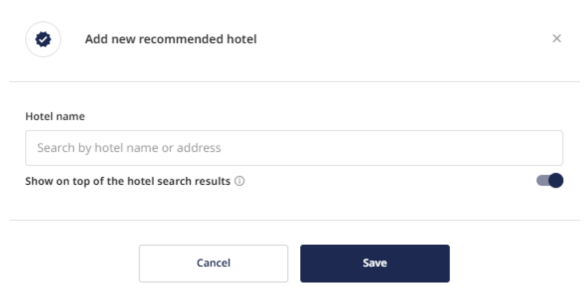
Simply signing a contract isn't enough. Employees need to know which offers to choose and why they're beneficial to the organization. On the worktrips.com platform, companies can mark selected properties as recommended hotels and rank them high in search results. This solution works well, for example, when the hotel is located near the client's office, meets the required standards, and offers a corporate rate.
Additional support comes from messages for employees.
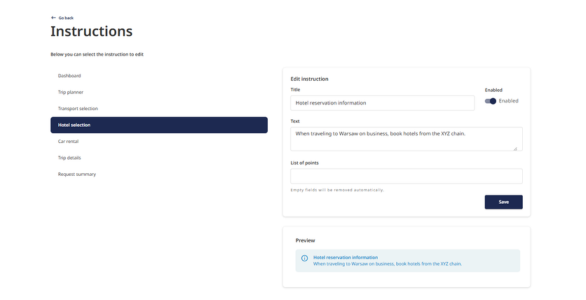
The company may remind you that when traveling for business to a specific city, you should first check out specific properties or offers from a specific chain. It's worth distinguishing three concepts:
| Element | Meaning |
|---|---|
| Negotiated rate | Price and booking conditions agreed with the supplier |
| Recommended hotel | A property recommended by the company, e.g. due to price or location |
| Travel Policy | Rules defining limits, standards and how reservations are accepted |
A recommended hotel doesn't necessarily have a negotiated rate, and a negotiated rate doesn't always mean you have to choose that property. This depends on the company's policies. For more information on how to develop these policies, see Travel Policies for Companies Using Online Tools.
Frequently asked questions
After implementing the worktrips.com platform, does the company keep its own rates?
Yes. Companies can transfer their hotel or airline contracts to WorkTrips. Negotiated rates are then implemented in their accounts and made available to employees.
Can an employee only search for offers with the company rate?
On the worktips.com platform, users can use the "own rates" option to search for offers available on terms negotiated by their company.
Can only large companies negotiate hotel prices?
This isn't solely determined by the number of employees. The regularity of stays, the number of overnight stays in a given location, and the ability to estimate future demand are key factors.
Does the corporate rate always mean the lowest price?
No. A public rate may be temporarily cheaper, so you should compare the same room type, additional services, and cancellation policies. A corporate rate may offer other benefits, such as greater flexibility or cost predictability.
Does the loyalty program replace the corporate tariff?
No. The corporate tariff specifies the terms of purchase, while the loyalty program allows you to earn points or miles. Both mechanisms can be used simultaneously.