


Per diem allowance for business travel: who is entitled to it and how is it calculated?
In this guide, you will read about:
- Business travel daily allowances: a quick answer
- Who is entitled to a daily allowance?
- Business travel versus a temporary assignment
- What does the daily allowance cover, and what is excluded?
- Business travel: costs incurred
- Business travel: expenses covered
- Domestic business travel: rate and time thresholds
- Domestic business travel lasting no more than 24 hours
- Domestic travel lasting longer than 24 hours
- Domestic daily allowance calculation example: 30 hours
- Domestic daily allowance calculation example: 34 hours
- How do meals reduce the domestic daily allowance?
- Example of a daily allowance calculation with meals
- When is no daily allowance payable for domestic travel?
- International daily allowance: how do you determine the rate?
- When does international travel begin and end?
- How do you calculate the duration and amount of the international daily allowance?
- International daily allowance calculation example
- Meals during international travel
- Example with breakfast provided
- How do you account for the domestic and international legs of one trip?
- Do you need a receipt for the daily allowance?
- How do you calculate the daily allowance in seven steps?
- Step 1: Check whether the trip qualifies as business travel
- Step 2: Determine when the trip starts and ends
- Step 3: Count the hours
- Step 4: Divide the trip into domestic and international legs
- Step 5: Apply the correct rates
- Step 6: Deduct meals provided
- Step 7: Include the daily allowance in the overall expense claim
- Daily allowances and expense claims on worktrips.com
- Common mistakes when calculating daily allowances
- Counting dates instead of hours
- Applying the one-day trip threshold to the next 24-hour period
- Counting the international leg from the moment the employee leaves home
- Overlooking breakfast included in the hotel price
- Mixing the daily allowance with other costs
- Failing to link the information to the business trip
- Accurate calculations start with accurate data
- Frequently asked questions about business travel daily allowances

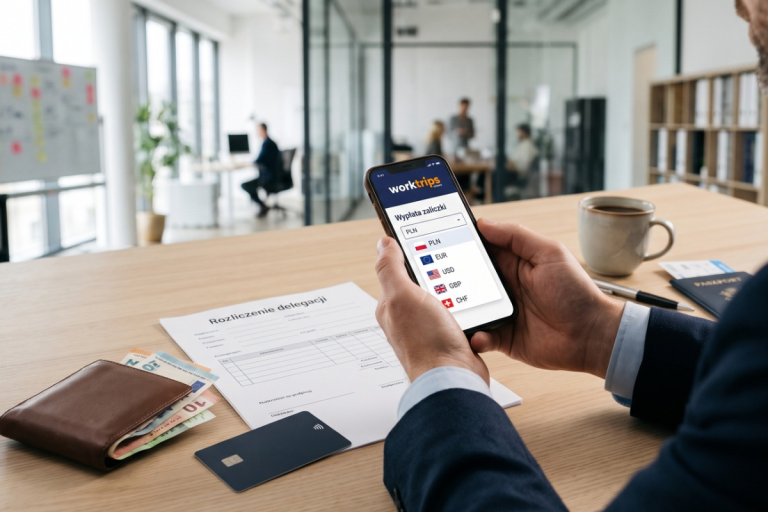
If you travel on business, a daily allowance may be one of the items in your expense claim. It is certainly not a bonus for going on a trip. It is intended to cover the additional cost of meals incurred away from your usual place of work. For international trips, it also covers other incidental expenses. First, the key points: the domestic daily allowance is currently 45 zł per 24-hour period. The international daily allowance depends on the destination country. However, the final allowance amount depends on more than just the rate. The exact departure and return times, any meals provided, and whether the trip was domestic, international or a combination of both all matter. In this guide, we walk you through the calculation without the accounting maze. We also show how worktrips.com connects the allowance with the travel request, booking, documents and final business travel expense claim.
Business travel daily allowances: a quick answer
An employee is entitled to a daily allowance when, at their employer's instruction, they carry out a task outside the town or city where the company's registered office is located or outside their usual place of work, provided that the trip qualifies as business travel. The key rules are as follows:
The current rules are set out in the regulation on business travel entitlements. The rules are also explained in an accessible format by the Ministry of Family, Labour and Social Policy.
Who is entitled to a daily allowance?
An employee on a business trip carries out a specific task assigned by their employer outside their usual place of work or outside the town or city where the company's registered office is located. In such cases, a daily allowance is payable once the relevant time thresholds are met, taking any meals provided into account. Keep in mind that not every trip outside the office automatically qualifies as business travel. You need to check:
- the place of work specified in the employment contract;
- the travel instruction and purpose of the trip;
- the departure and return towns or cities;
- the actual duration of the business trip;
- the employer's rules.
For example, an employee whose contractual place of work is Warsaw travels to a meeting in Poznań. This trip may qualify as business travel. However, if their place of work covers the entire Mazowieckie region, journeys within that area may not qualify. The basis for the business trip also matters: a work task carried out at the employer's instruction. An employee is not entitled to a daily allowance simply because they are away from home.
Business travel versus a temporary assignment
An employee's business trip is an occasional journey made to carry out a specific task away from their usual place of work. A temporary assignment usually involves a temporary change in the place where work is performed. These terms are not interchangeable, and distinguishing between them correctly determines the employee's daily allowance entitlements. This guide concerns employees. Expense rules for business owners, contractors and people working under civil-law contracts require a separate assessment.
What does the daily allowance cover, and what is excluded?
Business travel costs consist of several separate components. The daily allowance covers additional meal costs and, for international trips, other incidental expenses. Transport, accommodation, local travel, mileage reimbursement and other approved costs are accounted for separately.
| Expense claim item | What does it cover? |
| Daily allowance | additional meal costs; abroad, other incidental expenses as well |
| Travel | train, flight or bus tickets, or other approved transport costs |
| Accommodation | hotel costs or the applicable flat-rate allowance, provided the conditions are met |
| Local travel | a flat-rate allowance or approved, documented journeys |
| Other expenses | for example, parking, motorway tolls, baggage or other justified costs accepted by the employer |
Business travel expenses should not all be treated in the same way. The daily allowance, hotel and ticket may relate to the same trip, but each is accounted for under different rules. For the full picture, see our guide: Business travel expense claims step by step.
Business travel: costs incurred
The phrase “costs incurred on business travel” is best understood as a question about which costs the company pays and which the employee may initially have to cover. As a rule, the employer should cover recognised business travel costs in accordance with the applicable regulations and company policy.
Business travel: expenses covered
Items funded by the employer may include the daily allowance, reimbursement of travel costs, a hotel paid for directly by the company, a ticket purchased by the company or an employee's approved expense.
Domestic business travel: rate and time thresholds
The full domestic daily allowance is 45 zł. However, this does not mean that every one-day trip entitles the employee to the full amount. The exact number of hours matters.
Domestic business travel lasting no more than 24 hours
| Trip duration | Amount payable |
| less than 8 hours | no daily allowance payable |
| 8 to 12 hours | 50% of the daily allowance, or 22,50 zł |
| more than 12 hours | 45 zł |
Domestic travel lasting longer than 24 hours
45 zł is payable for each full 24-hour period. The final, incomplete period is calculated as follows:
| Final incomplete 24-hour period | Amount payable |
| up to 8 hours | 50% of the daily allowance, or 22,50 zł |
| more than 8 hours | 45 zł |
This is an important distinction. When a business trip lasts longer than 24 hours, the next 24-hour period is subject to different thresholds from a standalone one-day trip. For 6 hours after a full 24-hour period, half the rate is payable, but for 10 hours after a full 24-hour period, the full daily allowance is payable.
Domestic daily allowance calculation example: 30 hours
An employee left on Monday at 8:00 and returned on Tuesday at 14:00. The domestic trip lasted 30 hours:
- first full 24-hour period: 45 zł;
- next 6 hours: 22,50 zł.
The daily allowance totals 67,50 zł before deductions for meals provided.
Domestic daily allowance calculation example: 34 hours
The first 24 hours give an entitlement to 45 zł. There are 10 hours remaining, which is more than 8 hours of the next 24-hour period. In this case, the full 45 zł is payable for the second part of the trip:
45 zł + 45 zł = 90 zł.
This example of a 34-hour trip clearly shows why a four-hour difference can change the result by 22,50 zł.
How do meals reduce the domestic daily allowance?
Domestic daily allowance rates must be considered alongside any meals provided to the employee. For the full rate of 45 zł, the deductions are as follows:
| Meal provided | Deduction | Amount |
| breakfast | 25% | 11,25 zł |
| lunch | 50% | 22,50 zł |
| dinner | 25% | 11,25 zł |
If free meals are provided for the entire day, no domestic daily allowance is payable. Breakfast included in the accommodation price also counts as a provided meal.
Example of a daily allowance calculation with meals
The trip lasted 30 hours, so the amount payable before deductions was 67,50 zł. The employee was provided with breakfast and lunch:
- breakfast: 11,25 zł;
- lunch: 22,50 zł.
67,50 zł – 11,25 zł – 22,50 zł = 33,75 zł.
Do not deduct a meal that the employee bought themselves using their daily allowance. Deductions apply to food provided free of charge by the employer, hotel, business partner or event organiser.
When is no daily allowance payable for domestic travel?
No domestic daily allowance is payable when:
- the trip lasts less than 8 hours;
- the employee is provided with free meals for the entire day;
- the employee is sent to the town or city of their permanent or temporary residence;
- the specific case of returning to the place of residence during a longer business trip, as set out in the regulation, applies.
Having no entitlement to a daily allowance does not cancel other entitlements. Reimbursement of travel, accommodation or approved expenses may still be payable.
International daily allowance: how do you determine the rate?
There is no single international daily allowance rate for all countries. The rate is set in the annex to the regulation and is based on the destination country. If an international business trip covers several countries, the employer may specify more than one destination country. You can check the current daily allowance rates for selected countries in the domestic and international business travel calculator. The tool helps estimate the daily allowance, mileage reimbursement and additional business travel expenses. The result should then be checked against company policy and the supporting documents.
When does international travel begin and end?
The start of the international journey depends on the means of transport:
| Means of transport | Start of the international leg | End of the international leg |
| land transport | crossing the Polish border on the outward journey | crossing the border on the return journey |
| aircraft | take-off from the last airport in Poland | landing at the first airport in Poland |
| ship or ferry | departure from the last Polish port | arrival at the first Polish port |
For air travel, the international journey begins at take-off from the last airport in Poland. For land transport, it begins when the border is crossed. The preceding leg within Poland should be accounted for under domestic travel rules.
If the connection to the international flight is in Warsaw, international travel only begins when the aircraft takes off from Warsaw. If the employee returns by air, the international journey ends upon landing at the first airport in Poland.
How do you calculate the duration and amount of the international daily allowance?
For each full 24-hour period, 100% of the rate applicable to the destination country is payable. For the final incomplete 24-hour period:
| Duration of the incomplete 24-hour period | Amount payable |
| up to 8 hours | 1/3 of the daily allowance |
| more than 8 and up to 12 hours | 50% of the daily allowance |
| more than 12 hours | 100% of the rate |
The international daily allowance therefore depends on the country rate and the number of full and incomplete 24-hour periods. Even if the final part of the trip lasts only 4 hours, 1/3 of the rate is payable.
International daily allowance calculation example
Assume that the destination country rate is 50 euros and the international business trip lasts 30 hours:
- first 24 hours: 50 euros;
- remaining 6 hours: 1/3 of the rate, or 16,67 euros.
The total payable is 66,67 euros before deductions for meals.
Meals during international travel
| Meal provided | Deduction from the full rate |
| breakfast | 15% |
| lunch | 30% |
| dinner | 30% |
If the employee is provided with meals for the entire day, they retain 25% of the international daily allowance. If they receive a separate cash allowance for food, the daily allowance is generally not payable; if that payment is lower than the daily allowance, the difference must be paid.
Example with breakfast provided
At a rate of 50 euros for a 30-hour trip, the daily allowance before deductions is 66,67 euros. One breakfast reduces it by 7,50 euros:
66,67 euros – 7,50 euros = 59,17 euros.
How do you account for the domestic and international legs of one trip?
An international business trip often begins with a domestic leg. An employee may travel by train from Poznań to Warsaw airport before flying abroad. In that case, the business travel time must be divided as follows:
- From departure from Poznań to take-off from Warsaw: domestic rules.
- From take-off from Warsaw to landing at the first airport in Poland on the return journey: international rules.
- From landing in Poland to returning to the specified town or city: domestic rules again.
In this scenario, the business trip includes two domestic legs and one international leg. Each is calculated separately and then combined in a single expense claim.
Do you need a receipt for the daily allowance?
No. Neither the domestic nor the international daily allowance reimburses the price of a specific meal. Food receipts are not attached to the allowance claim. However, you need the information required to calculate the allowance:
Invoices, tickets and receipts document other business travel costs. You can find the full list in our guide: What documents are needed for a business travel expense claim?
How do you calculate the daily allowance in seven steps?
Step 1: Check whether the trip qualifies as business travel
Check the place of work, purpose and travel instruction. Every business trip must be assessed on the basis of what actually happened, rather than simply the name of the form.
Step 2: Determine when the trip starts and ends
The start and end of a business trip should reflect the travel instruction and actual times. The journey does not always begin when the employee leaves home; the employer specifies the towns or cities where the trip starts and ends.
Step 3: Count the hours
The duration of the business trip determines whether no allowance, half, 1/3 or the full amount is payable.
Step 4: Divide the trip into domestic and international legs
If the trip combines travel within Poland with a flight or journey abroad, do not calculate the entire duration using a single rate. The employee's domestic and international legs require separate calculations.
Step 5: Apply the correct rates
Check the domestic daily allowance rate or the destination country rate. The full amount is payable only once the relevant time threshold is met.
Step 6: Deduct meals provided
Include hotel breakfasts, lunches during conferences or other work activities, and dinners paid for by a business partner, for example. Do not deduct meals bought by the employee using their daily allowance.
Step 7: Include the daily allowance in the overall expense claim
When preparing a business travel expense claim, include the daily allowance, transport, accommodation, mileage reimbursement, other expenses and any advance in a single process. If funds were provided before departure, see also how to pay and account for a business travel advance.
When preparing the expense claim, there should be no need to enter the information from the travel request a second time. If a business trip lasts several days, the system or form should retain an accurate record of its course. Business travel time, the purpose of the trip and meals provided form the basis of the calculation.
Daily allowances and expense claims on worktrips.com
In the worktrips.com business travel module the daily allowance is part of the entire travel workflow, rather than a separate spreadsheet passed between the employee, manager and accounting team. The process is as follows:
- The employee creates a request and enters the destination, purpose and dates of the trip.
- The request is sent to the appropriate person in accordance with the approval workflow.
- Once approved, the employee can proceed to book a hotel, flight, train or car rental.
- After returning, they enter the actual travel times, meals provided, mileage and other expenses.
- The system links the information to the specific business trip and prepares the expense claim for further approval.
Hotel accommodation and transport already booked on worktrips.com do not need to be entered manually into the expense claim again. Business travel expenses, documents, advances and daily allowances remain linked to the correct trip. When managing a larger number of trips, the business travel module brings the request, approval, booking and expense claim together in a single process.
Common mistakes when calculating daily allowances
Counting dates instead of hours
Travel time is counted from the specified start to the end of the trip. Two calendar dates do not automatically mean two daily allowances.
Applying the one-day trip threshold to the next 24-hour period
For a trip lasting less than 24 hours, the full domestic rate is payable once 12 hours have been exceeded. Once a full 24-hour period has elapsed, the next period qualifies for the full rate after more than 8 hours.
Counting the international leg from the moment the employee leaves home
For an international flight, the international leg of the business trip only begins at take-off from the last airport in Poland. Travel to the airport must be accounted for as a domestic leg.
Overlooking breakfast included in the hotel price
If the hotel provides breakfast, it affects the daily allowance even if the invoice does not show a separate price for the meal.
Mixing the daily allowance with other costs
Travel costs include more than the daily allowance. Tickets, hotels, taxi fares and parking are accounted for under different rules.
Failing to link the information to the business trip
When preparing an expense claim, you need to be certain which trip the times, meals and expenses relate to. Manually copying information from messages into a spreadsheet increases the risk of errors.
Accurate calculations start with accurate data
Calculation problems arise when travel times are in one form, meal details in a hotel message and the remaining business travel costs in several files. Even straightforward daily allowance amounts then start to require extra messages, corrections and manual checks. On worktrips.com, the request, approval, booking, documents and expense claim can all remain part of a single process. This means the employee's domestic travel, international business trip and final amounts payable are recorded in the same place. Try the worktrips.com business travel module and see how to organise daily allowances, mileage reimbursement, advances and other expenses without creating yet another spreadsheet.
This article is for information purposes. Before preparing an expense claim for a specific trip, check the current regulations and your employer's rules.
Frequently asked questions about business travel daily allowances
How much is the domestic travel daily allowance?
The employee daily allowance is 45 zł for each full 24-hour period of domestic business travel. Private companies may set their own higher rates.
Is a daily allowance payable for 8 hours?
Yes. For a domestic trip lasting exactly 8 hours, the employee is entitled to a daily allowance of 22,50 zł. No allowance is payable for less than 8 hours.
Is the full rate payable for 12 hours?
No. For a domestic trip lasting exactly 12 hours, half the rate is payable. The full domestic daily allowance is payable only once 12 hours have been exceeded.
When does an incomplete 24-hour period qualify for 100% of the rate?
If a domestic trip has already lasted more than 24 hours, the full daily allowance is payable when the next incomplete period exceeds 8 hours. For an incomplete 24-hour period abroad, the full rate applies after more than 12 hours.
Does hotel breakfast reduce the daily allowance?
Yes. Breakfast provided as part of accommodation reduces the domestic daily allowance by 25% of the full rate and the international allowance by 15%.
Does lunch bought by the employee reduce the daily allowance?
No. The deduction applies to a meal provided to the employee. Buying food with personal funds or the daily allowance received does not result in a further deduction.
Are business travel daily allowances payable at weekends?
Yes, if a properly authorised business trip continues over the weekend. Daily allowances depend on the duration and course of the trip, rather than whether the day is a working day.
Are business travel daily allowances payable at weekends?
Yes, if a properly authorised business trip continues over the weekend. Daily allowances depend on the duration and course of the trip, rather than whether the day is a working day.
Is the daily allowance payment for hours spent travelling?
No. The daily allowance covers additional meal costs. Pay, working time and any overtime are accounted for separately.
Does the daily allowance require an invoice?
No. The calculation requires travel times, the route and meal information. Invoices and receipts document other costs.
What is the deadline for submitting an expense claim?
Under the regulation, the employee must submit their expense claim no later than 14 days after the trip ends. The company may specify its internal document and approval workflow.
Can the employer pay a higher daily allowance?
Yes. Employers may apply business travel daily allowance rates above the statutory minimum. However, any amount exceeding the tax- and social-security-exempt limits may require appropriate accounting treatment.
Does a hospital stay abroad affect the daily allowance?
Yes. For each day spent in a hospital or another healthcare facility during an international trip, 25% of the daily allowance is payable.
How do you account for a business trip to several countries?
The employer may specify more than one destination country. The daily allowance amounts must then be calculated for the time spent in each country using the relevant rates.